
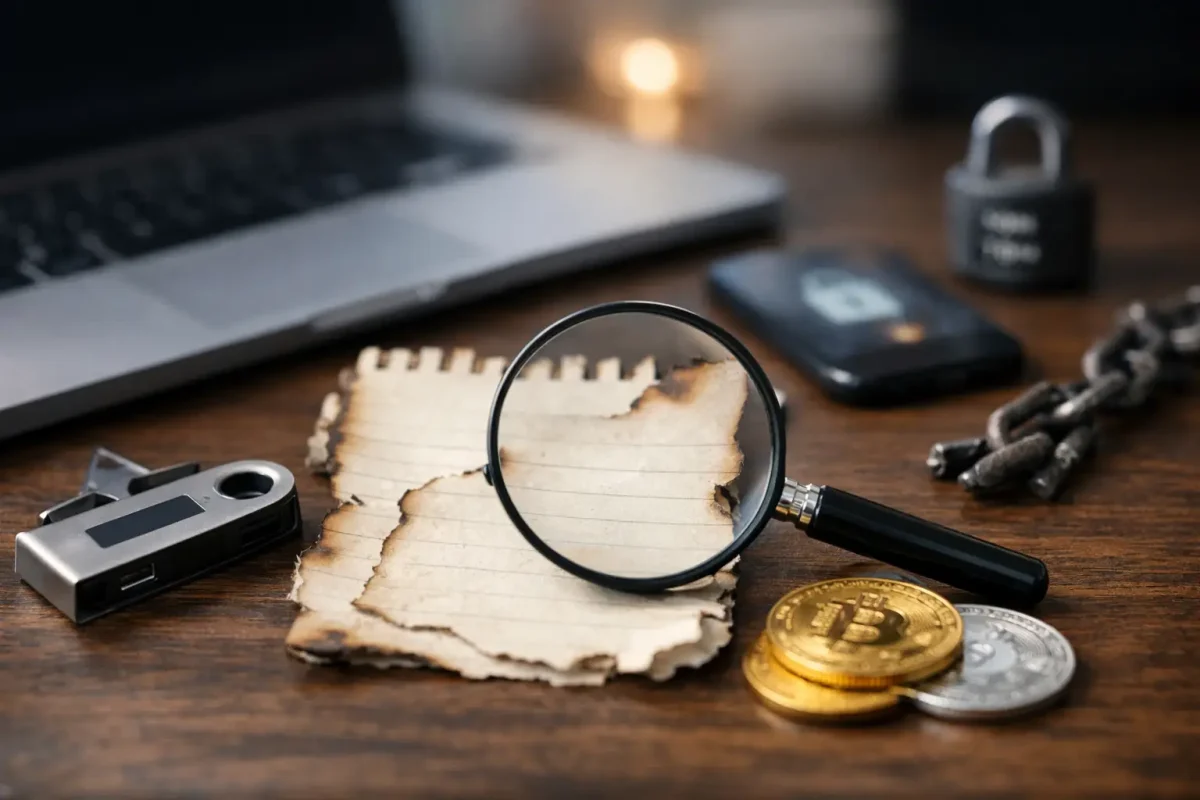
A missing seed phrase can turn a wallet balance into an urgent, deeply personal problem. The right lost seed phrase recovery options depend on one fact that cannot be avoided: whether any usable information still exists beyond the missing words. A legitimate recovery effort starts with evidence, not promises.
A seed phrase is not a password that a wallet provider can reset. It is the cryptographic backup that generates the private keys controlling a self-custody wallet. If every copy of the phrase and every related clue is truly gone, the wallet cannot be recreated by guessing, contacting blockchain support, or reversing a transaction. Bitcoin, Ethereum, and other decentralized networks have no central authority with a master key.
That reality is difficult, but it also helps focus the next steps. Many cases that seem impossible involve partial records, legacy devices, wallet files, password habits, or damaged backups that may support a professional evaluation.
What Seed Phrase Recovery Can and Cannot Do
A standard recovery phrase usually contains 12 or 24 words selected from a defined word list. The words, their exact spelling, and their exact order all matter. One wrong word can create an entirely different wallet. A missing phrase is therefore not something that can be retrieved from a public blockchain, even when the wallet address and its transaction history are visible.
Blockchain forensics can identify balances, trace outgoing transfers, and establish whether a wallet was active. It cannot reveal the private key or seed phrase behind an address. Anyone claiming they can extract a seed phrase from a wallet address alone is misrepresenting what the technology can do.
Recovery may be viable when there is a constrained problem to solve. For example, you may have 11 of 12 words, several possible words for one position, a photo with obscured text, an old wallet backup, or access to a device that once held the wallet. In these situations, specialists can assess the available evidence and determine whether targeted reconstruction is technically realistic.
The difference matters. A controlled search based on known information is not the same as blindly trying trillions of possible phrases. The former can sometimes be evaluated and executed. The latter is not a credible recovery strategy.
Lost Seed Phrase Recovery Options to Assess First
Before changing devices, deleting applications, or responding to online offers, preserve what remains. Small details can be valuable, particularly when combined with wallet-specific technical evidence.
Review physical and digital backup trails
Think beyond a sheet of paper labeled “seed phrase.” Many holders wrote words in notebooks, stored fragments in secure documents, printed a backup, recorded a coded hint, or photographed a phrase before realizing the risk. Search carefully through storage locations, old files, encrypted drives, password managers, cloud archives, and email drafts.
Do not upload suspected seed phrase material to a website, shared folder, or chatbot. Do not email it to a recovery company. A reputable provider can explain what evidence is needed for an initial assessment without asking you to expose the full phrase.
Preserve old phones, computers, and wallet media
An old phone may contain an installed wallet application, encrypted local data, app settings, cached information, or an accessible session. A computer may hold wallet backups, browser-extension data, recovery notes, screenshots, or files associated with a hardware wallet.
Avoid factory resets, operating-system updates, cleanup tools, and repeated attempts to reinstall the wallet. These actions can overwrite data that may have forensic value. Keep the device powered safely, note its condition, and record any wallet name, version, operating system, and visible account details.
For Bitcoin Core users, an old wallet.dat file can be especially significant. If it is present, protected by a forgotten password, damaged, or tied to an older installation, specialized wallet-file analysis may offer a different route than seed phrase reconstruction. The same applies to encrypted backups from certain desktop and mobile wallets.
Document partial phrase information accurately
If you remember some words, write down only what you genuinely know. Include possible spellings, word positions, whether the phrase had 12 or 24 words, the wallet brand, approximate creation date, and any separate passphrase you may have used.
Do not fill gaps with assumptions until they become memories. A note that distinguishes “certain,” “likely,” and “possible” information is more useful than a polished but inaccurate phrase. The recovery effort becomes more feasible when uncertainty is clearly bounded.
Check for an additional passphrase
Some wallets allow a separate passphrase, sometimes called a 25th word, in addition to the standard recovery phrase. This feature creates a distinct wallet path. A correct 12- or 24-word phrase can appear to show a zero balance if the additional passphrase is omitted, entered differently, or remembered incorrectly.
This is one reason wallet restoration should be approached methodically. A zero balance does not always mean the assets are gone, but it should never be treated as proof that a random phrase is correct.
When Professional Forensic Evaluation Makes Sense
Professional help is most appropriate when the wallet held meaningful assets and there is evidence to investigate. The goal is to establish a responsible path before sensitive material is handled or time is spent on an impossible search.
A proper evaluation examines the wallet type, chain, dates, known addresses, device availability, backup artifacts, password clues, and the scope of missing information. It also considers whether the case involves an inaccessible wallet, a corrupted file, a stolen asset event, or funds sent to the wrong network. These issues can look similar from the outside but require different technical methods.
Annonymously uses a confidential case-based process supported by blockchain forensics and wallet-access analysis. For qualifying cases, the work may include wallet reconstruction, encrypted-file assessment, transaction tracing, and targeted recovery execution. The process should remain transparent: you should understand what information is being evaluated, what outcome is technically possible, and what limitations apply.
No ethical specialist can guarantee recovery where all credentials are absent. A credible provider will not pressure you to reveal your complete seed phrase, install uncontrolled remote-access software, or pay a large advance fee based solely on a claim that the blockchain can be hacked.
Protect Your Remaining Assets From Recovery Scams
People searching for help are frequently targeted a second time. Fraudsters monitor social platforms and comment sections for posts about lost wallets, then pose as recovery agents, ethical hackers, government contacts, or former exchange employees.
Treat these warning signs seriously:
- A promise to recover any wallet using only its public address.
- A request for your complete seed phrase or private key before an evaluation.
- Instructions to connect your remaining wallet to an unfamiliar site or approve a transaction.
- Demands for payment in cryptocurrency to a personal address, especially with a deadline.
- Claims that a recovered balance must first be “unlocked” by paying tax, insurance, or a blockchain activation fee.
If you still have access to other wallets, move carefully. Never enter a valid seed phrase into a website suggested by a stranger. Verify wallet software independently, use a clean device where possible, and consider creating a new wallet for assets that remain under your control. Security after an incident is part of recovery, not an afterthought.
A Practical Path Forward
Start by separating what is lost from what is still available. You may have lost the phrase but retained an old device. You may have a damaged wallet file rather than a seed phrase problem. You may remember most of the phrase, or you may only have a public address and no credentials at all. Those distinctions determine whether technical recovery, forensic tracing, or asset-protection guidance is the appropriate next step.
Keep a private timeline of the wallet’s creation, deposits, transactions, devices, applications, backups, and any suspected compromise. Preserve evidence in its original state. Then seek an evaluation that is specific about the evidence required and candid about the chances of success.
The most helpful next move is not to chase a miracle solution. It is to protect the information and devices you still have, define the problem accurately, and let the available evidence determine the recovery path.
